













































We spend most of our time inside buildings, whether in public or private spaces. In this context, it becomes essential to design these environments in a way that provides comfort and enhances our quality of life.
Technological development and digitalization are gradually transforming buildings into smart spaces that support people’s health and well-being. Against this backdrop, European regulations and standards play an important role by setting clear performance criteria for such constructions.
How are European standards applied in Romania?
According to European regulations, all member states are required to adopt measures aimed at optimizing the energy efficiency of buildings.
Since 2020, all constructions in Romania must comply with EU provisions regarding the recommended indoor temperature levels. These standards were drafted by ASRO (the Romanian Standards Association) as part of the România Eficientă program, implemented by the Energy Policy Group.
High energy efficiency buildings offer major benefits: they minimize consumption and heating/cooling costs, increase comfort levels, and reduce the negative impact on the environment.
In addition to complying with legal requirements, it is essential that these standards be effectively applied to ensure a satisfactory indoor climate experience for occupants. An efficient solution in this regard is underfloor heating, which ensures an even temperature distribution and reduces energy consumption.
Thermal comfort and employee productivity
Office spaces should be designed to positively influence employees’ well-being and performance. Considering that a person spends approximately one-third of their life at work, companies have the responsibility to create a safe and supportive working environment.
A survey conducted by GBCI (Green Business Certification Inc.) in 2020 shows that only 62% of respondents are satisfied with the temperature conditions in their workplace, generally stating that temperatures are too low during winter and too high during summer.
The same study confirms that when the temperature is not adequate, employees’ work capacity can decrease by 4% under excessively cold conditions and by as much as 6% in excessively hot conditions.
For office spaces, it is recommended to maintain a temperature of 20°C, a level that supports a pleasant and balanced indoor climate.
Advantages of underfloor heating for offices and buildings
Underfloor heating offers numerous economic and functional benefits for buildings. One of its major advantages is space optimization, as office layouts are no longer influenced by the presence of radiators or heating units.
Another benefit is that the system ensures an even distribution of heat across the entire surface, preventing heat stratification and maintaining a constant indoor climate. At the same time, compared to conventional systems, these solutions provide significantly lower energy consumption.
Underfloor heating also contributes to improving indoor air quality. The reduced air circulation minimizes the spread of dust, odors, and allergens. This is because the heating system does not rely on vents or ducts, which typically accumulate bacteria and dust.
Moreover, regardless of the type of flooring – whether parquet, tile, carpet, concrete, or stone – the system maintains a consistent temperature level, contributing to a pleasant and comfortable working environment.
How does Homplex respond?
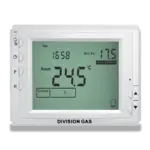
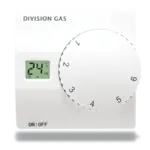
Homplex offers a wide range of equipment dedicated to underfloor heating systems, including electro-thermal actuators, thermostats, and central control units.
Electro-thermal actuators (or servomotors) are installed on manifolds and regulate the heating circuits according to the commands received from the temperature control unit. In this case, choosing the right model depends on the size of the manifold thread and the type of installation.

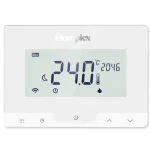
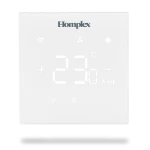
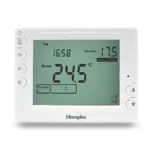
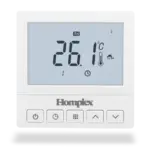
Thermostats compatible with underfloor heating systems allow precise temperature control and efficient energy management, helping to reduce heat loss.
The Homplex portfolio includes models equipped with advanced programming features, offering the possibility to set up operating schedules tailored to the needs of each space, thus optimizing energy consumption and operational costs.

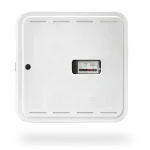
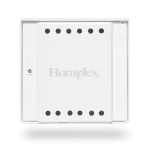
Central control units, available in both wireless and wired versions, allow simultaneous control of multiple zones through connected thermostats. Depending on the model, such a unit can manage several different areas, each equipped with a dedicated thermostat.

Considering that each project has specific requirements, Homplex offers underfloor heating solutions tailored to the particularities of each building.
Homplex specialists are available to provide technical consulting and dedicated support in choosing the optimal solution, contributing to the development of high-quality and sustainable projects.


No Comments yet!